


New Skilled Visa Processing Priorities Introduced Under Ministerial Direction 121 – Skills in Demand – Subclass 482
The Department of Home Affairs has introduced a new processing priority framework for certain temporary skilled visa applications, with Ministerial Direction 121 (MD121) and MD122 commencing on 19 September 2026.
MD121 replaces MD119 and applies to both the Skills in Demand (subclass 482) visa and any remaining Temporary Skill Shortage (subclass 482) visa applications. MD122 covers the remaining permanent and provisional skilled visa subclass that MD119 previously brought together.
What’s changing?
MD121 responds to the Government’s announcement on 17 September 2026 by broadening the occupations that receive priority processing for the skills in demand visa.
The highest priority is now given to primary applicants working in specified occupations across:
- Construction
- Healthcare
- Teaching
- Agriculture
- Aquaculture
- Fishing
- Resources
- Australia’s law enforcement interests
- Australia’s defence interests
Importantly, applicants in these priority occupations receive the highest processing priority regardless of whether they were in Australia or overseas when their visa application was lodged.
The Specialist Skills stream of the Skills in Demand visa has also been restored as a specific priority category under the new Direction.
New order of processing priority
Under MD121, subclass 482 visa applications will generally be processed in the following order:
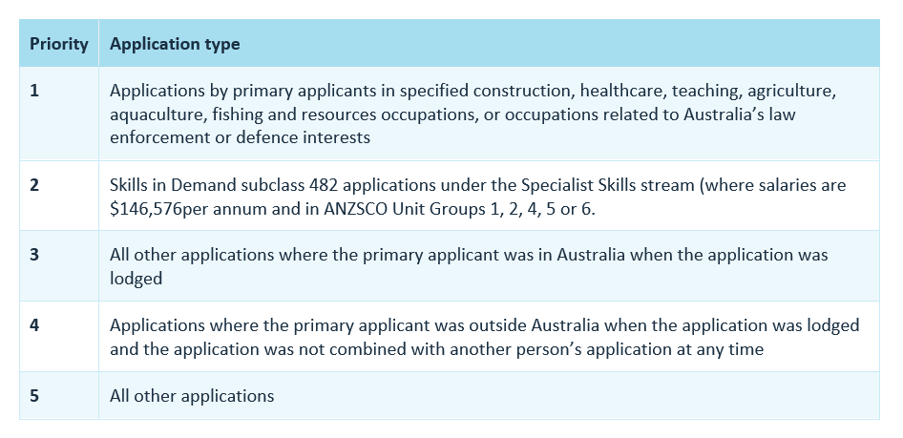
Family members whose applications are validly combined with the primary applicant’s application receive the same priority as the primary applicant.
Priority occupation categories
MD121 does not simply prioritise every occupation operating within a named industry. The nominated position must fall within the definitions and occupation groups specified in the Direction.
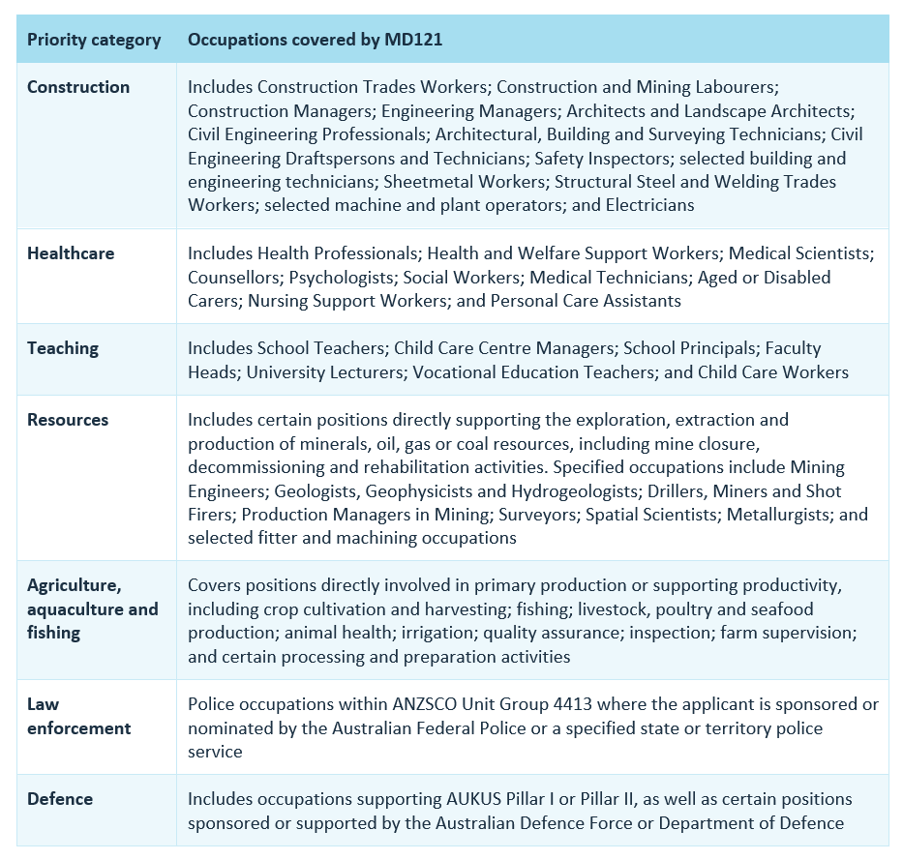
The occupations within each defined category have equal priority. MD121 does not create a further ranking between, for example, a healthcare occupation and a resources occupation.
What does this mean for employers?
The most significant change is that offshore applicants in the newly expanded priority sectors are no longer placed behind other applicants simply because they were outside Australia when their application was lodged.
For employers sponsoring skilled workers, MD121 may result in:
- Improved processing priority for qualifying offshore applicants in resources, agriculture, aquaculture and fishing (within the ANZSCO unit groups listed).
- Continued priority processing for qualifying construction, healthcare, teaching, law enforcement and defence occupations (within the ANZSCO unit groups listed).
- Restored priority status for subclass 482 Specialist Skills stream applications.
- Greater flexibility for employers that must recruit internationally because the required skills are not available in Australia.
- Continued delays for applications that do not fall within a priority occupation or the Specialist Skills stream, particularly applications involving offshore candidates.
- A need to examine the nominated occupation and the actual position carefully, rather than relying on the employer’s industry alone.
MD121 establishes the order in which applications are considered. It does not guarantee a particular processing timeframe or change the criteria that applicants and sponsors must satisfy.
The impact on subclass 482 applications
MD121 is specifically directed to temporary skilled visas and applies to the Skills in Demand subclass 482 visa.
One of the most welcome changes is the return of the Specialist Skills stream as a defined priority category. Under MD119, many employers found that Specialist Skills applications had lost the clear processing advantage previously expected for highly skilled and highly remunerated roles. Under MD121, these applications now sit immediately behind the designated priority occupations.
However, MD121 does not restore priority processing merely because an employer is an accredited sponsor or because the position is located in regional Australia. Unless the application falls within one of the occupation categories specified in the Direction or the Specialist Skills stream, its priority will generally continue to depend on whether the primary applicant was in Australia or overseas when the application was lodged.
A note for offshore applicants and accompanying family members
MD121 introduces a distinction between offshore primary applicants who lodge without combining their application with another person’s application and other applicants.
An offshore primary applicant whose application has not been combined with another person’s application at any time sits at priority four. Other applications that do not fall within the earlier categories sit at priority five. Where family members validly combine their applications with a primary applicant, they receive the same priority as the primary applicant.
Employers and applicants should obtain advice before making decisions about whether family members will lodge together or separately. Processing priority is only one consideration, and the timing and structure of family applications should be assessed against the family’s circumstances and the applicable visa requirements.
Does the new Direction affect applications already lodged?
Yes. MD121 applies to applications lodged before its commencement that had not been finally determined, as well as applications lodged from the commencement date onwards.
This means an existing subclass 482 application may be repositioned within the Department’s processing queue under the new priority framework.
We are still not sure about the delays to processing of the subclass 482 visa, so please ensure you continue to plan and allow plenty of time for processing of the application. We will provide more updates on processing times the further we are into this new direction.

Can the Department depart from the priority order?
The Direction permits a decision-maker to depart from the specified processing order where satisfied that an application involves compelling circumstances.
Examples identified in MD121 include circumstances affecting community safety, the continuity of essential religious, cultural or community services in Australia, or Australia’s international relations. This is a narrow exception and should not be treated as a general business-urgency or expedited-processing mechanism.
What should employers do now?
Employers using the subclass 482 program should:
- Review current and planned applications to identify whether the nominated position falls within an MD121 priority occupation.
- Confirm whether Specialist Skills stream applications can now be treated as priority applications.
- Reassess anticipated timelines for offshore candidates whose applications previously sat outside the MD119 priority cohorts.
- Avoid assuming that an occupation is prioritised merely because the employer operates in resources, agriculture, construction, healthcare or another named sector.
- Lodge decision-ready applications with complete supporting evidence to minimise avoidable delays.
- Continue building realistic lead times into recruitment, onboarding, mobilisation and project planning.
- Seek tailored advice where an occupation could fall within one of the sector definitions or where family members are considering separate applications.
Takeaway
MD121 is a positive development for employers in the resources, agriculture, aquaculture and fishing sectors, particularly those recruiting skilled workers from overseas. It also restores a clear priority position for the Specialist Skills stream and removes the onshore versus offshore distinction for applicants in the highest-priority occupations.
However, the Direction remains targeted. Being an accredited sponsor, operating in a regional location or working broadly within a priority industry does not, by itself, establish priority. The particular nominated position must meet the definitions in MD121, and applications outside the designated occupations and Specialist Skills stream may continue to experience longer processing timeframes. Mapien will continue to lobby for change and will be putting our submission forward shortly to the Minister.
MD121 changes processing order, not visa eligibility, and it does not guarantee how quickly an individual application will be decided. Employers should continue to plan conservatively, lodge complete applications and obtain advice about how the new priorities apply to their workforce program.

Connect with us
If you would like to understand how MD121 may affect your current or future sponsorship program, including whether a nominated position falls within one of the new priority categories, please contact the Mapien Migration team below.