

AI isn’t replacing jobs - It’s rewriting the work
AI is dominating workforce debate, but recent Australian evidence suggests the impact is less dramatic than the headlines imply.
The July 2026 Department of Employment and Workplace Relations AI and Employment in Australia report found no evidence of widespread AI-driven job losses or labour market disruption. Employment remains strong, youth employment is stable, and occupational change has not accelerated since ChatGPT.
What is changing is growth. AI-exposed roles, especially routine clerical and administrative work, are growing more slowly than less-exposed occupations, but they are still growing overall.
Skills, not jobs, are being disrupted
The report reinforces a key workforce trend: AI affects tasks before jobs. It automates, augments and creates work, shifting skill needs rather than replacing whole roles.
Even roles seen as vulnerable continue to grow. Software and Applications Programmers, for example, have increased by around 25% since ChatGPT was released.
What this means for leaders
The challenge is no longer, “Which jobs will AI replace?” It is, “Which skills will create value in an AI-enabled organisation?”
Leading organisations are investing in the below, before or alongside technology implementation:
- Job redesign
- Work and skills architecture
- Capability frameworks
- Workforce planning
- Continuous learning
Key takeaway
AI is not eliminating jobs at scale; it is reshaping work and accelerating the move to skills-based organisations.
Those that thrive will focus less on headcount reduction and more on capability, job redesign and helping people work effectively with AI.

Connect with us
If you have concerns regarding the impact of AI in the workplace, please contact us below and one of Workplace Strategists will be in touch within 24 hours.
When we think about human-robot interaction, those movie buffs among us tend to picture Will Smith in iRobot being chased by the robots, or we picture the Terminator relentlessly pursuing John Connor. There were lessons to be learnt from those films to the point that today we reluctantly and carefully observe robotic dogs scanning shipping containers or robotic machines doing work in our workplaces, wondering if they will one day turn on us and take over. But then reality sets in and we realise that robots are going to be part of our working life and that’s ok. The question is, how do we invite them in and set us all up for success?
Human–robot interaction is no longer a future scenario, it is already reshaping workplaces across industries. From logistics and manufacturing to healthcare and services, advanced robotics are moving out of cages and into shared workspaces with people.
A new report from the European Foundation for the Improvement of Living and Working Conditions (Eurofound) (Human–robot interaction: What changes in the workplace? | Eurofound) highlights a clear shift; robots are no longer just tools, they are active participants in how work is organised, managed and experienced. But while the productivity gains are real, the workplace implications are far more complex.
This article summarises the key challenges emerging from human–robot interaction and the practical lessons employers could be taking now.
Work is becoming more controlled, not more autonomous
One of the clearest findings is that human–robot interaction often reduces worker autonomy, rather than increasing it.
- Robots increasingly determine work pace, sequencing and task allocation
- Workers are more likely to experience faster pace, reduced control and increased surveillance
- In highly automated environments, people often adapt to machine logic, not the other way around
In practical terms, this can create environments where work becomes highly standardised, tightly monitored, and algorithmically managed.
Why it matters:
Left unmanaged, this undermines job quality, engagement and trust, even in technically advanced environments.
Productivity gains come with psychosocial risk
While robotics reduce physical strain, they introduce new forms of psychological pressure.
The report highlights emerging risks such as:
- Increased work intensity and time pressure
- Greater monitoring and data-driven oversight
- Rising cognitive load and mental demand
- Anxiety around job security, accountability and technology dependence
Critically, many organisations still focus on physical safety, while overlooking psychosocial impacts.
Why it matters:
The shift is not just from physical to digital work, it’s from physical risk to cognitive and emotional risk.
Technology design is rarely human-centred
A consistent theme in the report is that human factors are often secondary to productivity goals.
- Technology decisions are typically top-down, with limited worker involvement
- Systems are frequently designed for efficiency first, human experience later
- Workers are often treated as components in the system, rather than co-designers of it
Where employees are more involved (e.g. co-design or pilot phases), outcomes are noticeably better in terms of trust and adoption.
Why it matters:
Poorly designed systems don’t just fail culturally, they also underperform operationally.
Skills gaps are emerging, but are not being addressed holistically
Robotics is changing skill requirements – but most organisations are not responding strategically.
- New demands include digital, analytical and problem-solving capabilities
- Yet training is often narrow, short-term, and focused only on safe operation
- Few organisations link training to career development or long-term workforce strategy
In many environments, workers are expected to adapt, without structured support.
Why it matters:
Without investment in capability, organisations risk creating:
- disengaged workforces
- fragile operating models
- and limited innovation capacity
Monitoring, data and surveillance are accelerating
Advanced robotics bring real-time data collection and visibility into work.
- Systems capture highly detailed data on tasks, outputs and performance
- Monitoring often becomes embedded and unavoidable in daily work processes
- Governance frameworks for data use are often underdeveloped or reactive
Even where organisations deny individual-level monitoring, the capability is there, raising ethical and legal questions.
Why it matters:
This is less about technology — and more about trust, transparency and governance.
Benefits are not always shared with workers
Despite clear productivity gains:
- There is little evidence of improved pay or career progression
- Work intensity may increase without corresponding rewards
- Efficiency gains are often reinvested in output, not workforce outcomes
At the same time, fears of future job displacement remain.
Why it matters:
There is a growing disconnect between productivity outcomes and employee experience.
What does all this mean for employers
The overarching insight is clear; the risks of human–robot interaction are not driven by the technology itself, but by how organisations choose to design, implement and manage it.
This places responsibility squarely with leadership.

Key lessons for employers
1. Design work, not just technology
Robotics implementation must go beyond system deployment to include:
- task redesign
- workflow integration
- role clarity
Focus on how work feels and functions, not just how it operates.
2. Treat employees as co-creators
The strongest outcomes occur when organisations:
- involve employees in design, testing and rollout
- actively incorporate frontline insight
- build ownership and trust
This is not consultation, it is co-design.
3. Move from safety compliance to wellbeing strategy
Health and safety needs to expand to include:
- psychosocial risk
- cognitive load
- autonomy and control
A human-centric approach considers the full experience of work, not just physical harm.
4. Align automation with capability building
Training should evolve from:
- “how to operate the robot”
to:
- how to work alongside automation effectively
- how roles will evolve over time
This means embedding robotics into a broader workforce strategy and people policy.
5. Establish clear data and monitoring governance
Employers should proactively define:
- what is monitored (and why)
- how data is used
- where boundaries sit
Transparency is critical to maintaining trust.
6. Ensure fair distribution of value
Automation strategies should consider:
- how productivity gains are shared
- how roles evolve into higher-value work
- how employee experience improves alongside efficiency
Without this, organisations risk eroding engagement over time.
The bottom line
Human–robot interaction is not simply a technology trend, it is a workplace transformation challenge. Organisations that focus only on efficiency will capture short-term gains. Those that prioritise human-centric design, workforce capability and governance will unlock sustained performance.
At its core, the question is no longer, what can robots do? It’s, what kind of work are we designing, and for whom?
Connect with us
If your organisation is introducing automation or robotics into the workplace, now is the time to consider the human impact. Contact Mapien below to discuss how thoughtful work design, capability planning and governance can help your people and technology work better together.
The commencement of the 2026–27 financial year has brought a number of important changes affecting Australian employers, sponsored workers and visa applicants.
From 1 July 2026, the Department of Home Affairs has implemented substantial increases to visa application charges across a number of commonly used visa categories. Unlike previous years where increases have usually been in line with relevant CPI figures, this year an unprecedented 25% increase has been applied across almost all subclasses.
At the same time, the annual indexation of employer-sponsored visa income thresholds has taken effect, increasing the minimum salary requirements for certain employer-sponsored visas. The Fair Work High Income Threshold (FWHIT), which is relevant to the age exemption available under the Subclass 186 permanent employer nominated visa, has also increased.
The nomination charges associated with employer sponsored visa, and the Skilling Australians Fund Levy amounts remain unchanged.
Visa application charge increases
The following increases apply from 1 July 2026 (primary applicant fees only – note spouse and dependent child charges have also increased):
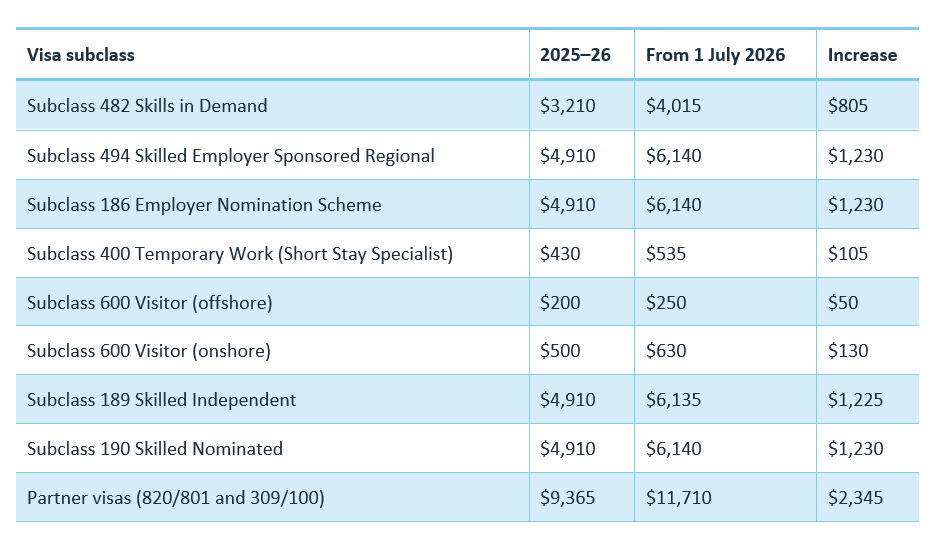
For employers supporting sponsored workers through temporary and permanent residence pathways, and for families lodging combined applications, these increases may have a significant impact on the overall cost of migration. Note however that the Department has introduced concessional fee arrangements across several visa subclasses for individuals from “Pacific Region” countries including Fiji, PNG, Samoa, Timor-Leste, Tonga, Solomon Islands, Tuvalu, Vanuatu, the Federated States of Micronesia and the Republic of Marshall Islands. Some concessions may also be available to student visa applicants from ASEAN countries.
New employer-sponsored salary thresholds
The annual indexation of employer-sponsored salary thresholds has also taken effect.
Core Skills Income Threshold (CSIT)
The CSIT applies to:
- Subclass 482 Skills in Demand visa (Core Skills stream)
- Subclass 186 nominations lodged on or after 7 December 2024

Specialist Skills Income Threshold (SSIT)
The SSIT applies to the Specialist Skills stream of the Subclass 482 visa.

Temporary Skilled Migration Income Threshold (TSMIT)
The TSMIT applies to Subclass 494 nominations.

Employers must continue to ensure that sponsored workers are paid at least the higher of the applicable threshold and the Annual Market Salary Rate (AMSR).
Fair Work High Income Threshold and Subclass 186 age exemptions
The Fair Work High Income Threshold (FWHIT) has increased from:
$183,100 to $190,100 from 1 July 2026.
This threshold is particularly relevant for certain applicants seeking to access an exemption from the standard age limit of 45 years under the Temporary Residence Transition (TRT) stream of the Subclass 186 Employer Nomination Scheme visa.
For employers with long-term sponsored workers approaching age 45, this serves as an important reminder to review remuneration arrangements and permanent residence planning well in advance as failure to meet the applicable FWHIT requirements in the two years immediately prior to application lodgement may impact eligibility for an age exemption.
Key takeaway for employers
These changes provide a timely opportunity for organisations to review their migration policies, budgeting assumptions and sponsorship practices.
Employers should ensure they understand:
- which sponsorship and nomination costs must legally be paid by the sponsoring employer;
- which costs cannot be recovered from employees;
- which visa-related costs may lawfully be paid by the visa applicant;
- how permanent residence support is managed across the organisation; and
- the likely impact of rising visa charges and salary thresholds on workforce planning and recruitment budgets.

With costs continuing to increase, a clear and compliant migration policy can help minimise risk, manage expectations and ensure consistency across the organisation.
Connect with us
If you would like assistance reviewing your migration program, sponsorship arrangements or permanent residence pathways for existing sponsored workers, please contact the Mapien Migration team below.
At the recent Ageing Australia Conference, Sarah Pettit (Chief Migration Agent at Mapien) attended a session led by Professor Gary Martin, CEO of AIM WA, on the “10 Quotients” required to build strong, effective teams. The framework, and the way it was brought to life, strongly resonated with Sarah, prompting reflection on how leadership has evolved in practice. The insights below draw on those reflections and their relevance in today’s leadership environment.
Rethinking leadership: beyond IQ to the “10 Quotients”
At the recent Ageing Australia Conference, Professor Gary Martin shared a compelling framework on the “10 Quotients” leaders need to build strong, effective teams.
The concept is simple, but the implications are significant. Leadership today is becoming both more complex and, importantly, more human. It’s a shift many leaders will recognise.
Early leadership models often placed emphasis on expertise – having the answers, maintaining control, and driving outcomes through capability alone. For many, this meant leaning heavily on intellectual strength. Over time, however, experience tends to challenge that assumption.
The moments that shape leadership are rarely about having the right answer. Instead, they are defined by how leaders respond in practice, support others when it matters, adapt when plans change, navigate difficult conversations, and create environments where people feel safe to contribute.
This is where leadership becomes more nuanced, and more impactful.
Professor Martin’s “10 Quotients” framework captures this evolution:
(1) IQ – Intellectual Quotient
Capability and sound judgement remain essential. Leaders must be able to navigate complexity and make informed decisions.
(2) EQ – Emotional Quotient
Self-awareness and the ability to connect meaningfully with others underpin strong, cohesive teams.
(3) AQ – Adaptability Quotient
Change is constant. The greater risk lies in resisting it—becoming what Martin describes as an “architect of decay.”
(4) SQ – Strategic Quotient
Effective leaders anticipate what lies ahead, while remaining close enough to bring their teams with them.
(5) WQ – Wellbeing Quotient
Sustainable leadership requires energy. Leaders who prioritise wellbeing are better positioned to support others.
(6) CQ – Cultural Quotient
Diverse perspectives strengthen teams. Inclusion goes beyond hiring practices—it requires intentional leadership.
(7) GQ – Generational Quotient
Different generations bring varying expectations and strengths. Avoiding assumptions is key to unlocking their value.
(8) DQ – Digital Quotient
From cyber risk to AI, leaders don’t need to know everything—but they do need to remain curious and informed.
(9) MQ – Moral Quotient
Strong leadership is grounded in values—knowing what is right and having the courage to act.
(10) TQ – Trust Quotient
Trust is foundational. It takes time to build and underpins every high-performing team.
The takeaway
Great leadership is no longer one-dimensional.
The thread connecting these quotients is not any single capability, but the ability to integrate different strengths to achieve collective outcomes.
In practice, this often means intentionally building teams with diverse perspectives, experiences, and approaches – recognising that stronger outcomes emerge from difference, not similarity.
Because leadership is not about having all the answers. It’s about creating the conditions where the team can find them together.

Connect with us
For more information or support creating confident, capable Leaders within your organisation, reach out to our team below. One of our Workplace Strategists will be in touch within 24 hours.
The introduction of the Aged Care Industry Labour Agreement (ACILA) in 2023 was widely welcomed. It marked a long‑overdue acknowledgement that migration must play a role alongside domestic workforce strategies.
For the first time, the Commonwealth formally recognised that direct care roles, including Personal Care Assistants, Nursing Support Workers and Aged or Disabled Carers, are essential to the sustainability of the aged care system.
Three years on, however, ACILA has fallen well short of what the sector requires.
While participation has increased and visa grants have risen since the scheme’s early rollout, the programme remains limited in its ability to address the size of the workforce gap. The shortfall is measured in tens of thousands. The 2025 Skills in Demand (SID) Report confirms that despite sustained visa usage, workforce shortages persist in ageing‑driven sectors such as aged care, highlighting the limits of current migration settings in addressing long‑term demand.
Parliamentary hearings and industry submissions have consistently highlighted the same issues. ACILA is often described as complex, administratively intensive and difficult for many providers to navigate, particularly smaller and regional operators.
Providers have raised concerns about lengthy approval processes, mandatory union consultation requirements, inconsistent implementation, visa delays, compliance obligations and extended lead times between recruitment and worker arrival.
For many providers, ACILA has therefore not operated as a practical workforce solution. Instead, it has added further complexity.
In practice, a narrow occupation list and restrictive age thresholds are further limiting access to suitable candidates, tightening an already tight labour pool. Providers are also left navigating multiple visa pathways for different skill levels, an added layer of complexity in a sector already operating within a highly regulated environment.
Peak bodies such as Ageing Australia, alongside organisations like CEDA and migration professionals, have continued to advocate for a more streamlined, fast‑tracked care worker visa pathway, reflecting models already in use internationally.
At the same time, broader migration policy settings continue to evolve, including the use of caps and other controls. While these mechanisms serve a range of policy objectives, they do not, in isolation, resolve structural workforce shortages in sectors such as aged care.

Restricting access to care workers without a viable alternative does not resolve the shortage — it simply shifts the pressure onto providers, hospitals and families, with older Australians absorbing the consequences.
Where access to care workers remains constrained, the impact is felt across the system — placing pressure on providers, hospitals and families, and ultimately affecting service delivery.
Without further refinement, workforce shortages are likely to continue to impact care provision, provider stability and the long term sustainability of the aged care system.
Evidence based reform needed
A related structural issue sits beyond ACILA itself. Continued reliance on ANZSCO classifications has not kept pace with how aged care work is performed in practice. The development of OSCA provides a more contemporary framework better defining modern care roles, and it is encouraging to see more accurate representation emerging.
Looking ahead, the 2025 Skills in Demand report indicates that migration settings will continue to be reviewed and refined as labour market evidence evolves, including consideration of how updated occupation classifications might be reflected in future frameworks. The report also flags further analysis of the aged care sector’s use of permanent and temporary visa programs — including ACILA, DAMAs and the PALM Scheme — alongside pathways between visas, retention of migrant workers and wage outcomes at a granular occupation level. Aligning migration policy with this evidence base would support more coherent and sustainable workforce planning over time.
While ACILA could be improved, our immigration experts have also seen it operate effectively for some providers and are working with organisations to support workforce strategies within the current framework.
Connect with us
If you have further questions or for more insights into workforce planning and migration pathways, please connect with our expert immigration team below.